
Lower Is Not Always Better — Choosing the Right Surface-Resistance Band for an ESD Tray
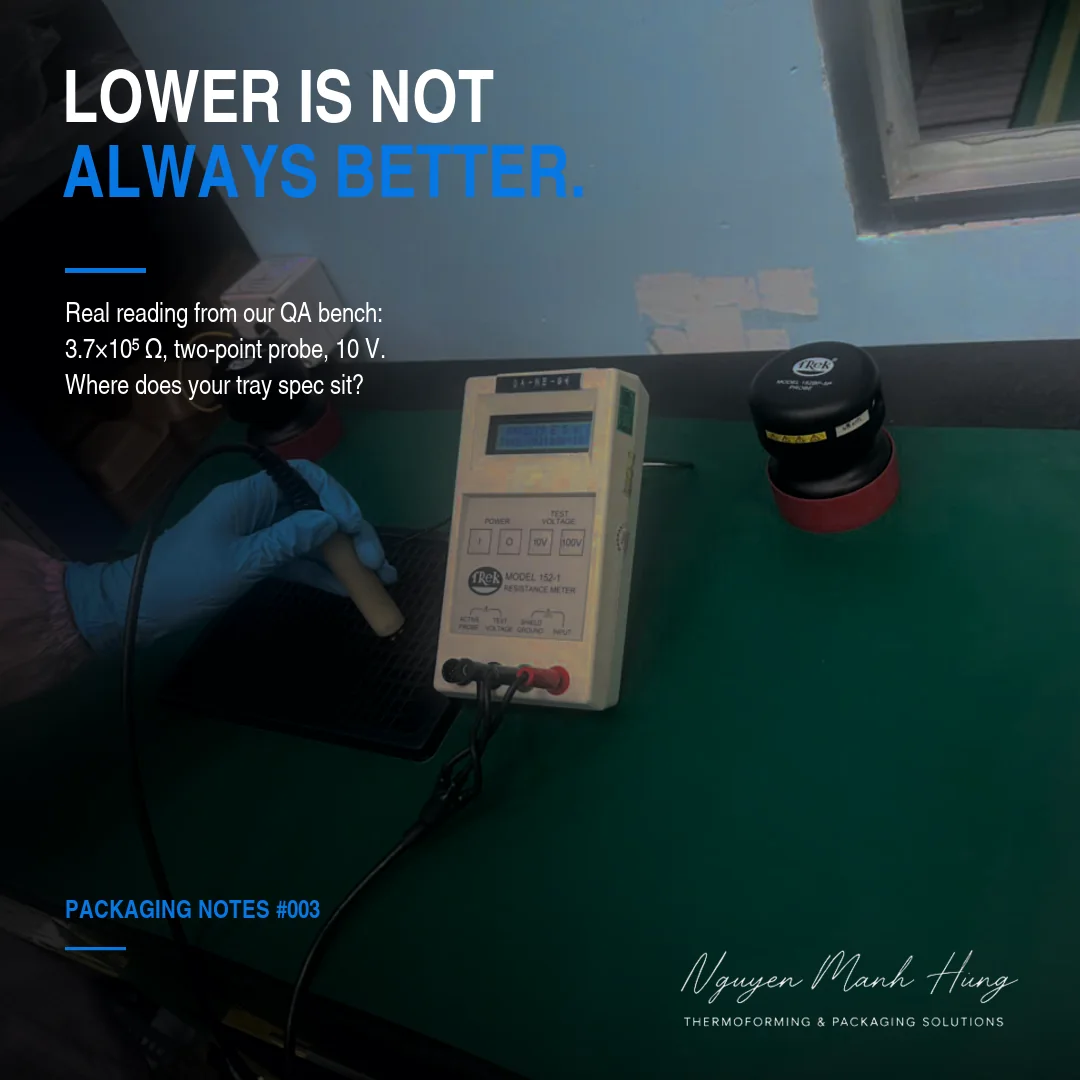
On the surface-resistance scale, lower is not always better — each band does a different job. Conductive (<104 ohm) transfers charge very quickly when a controlled path is available. Dissipative (104 to <1011 ohm) slows the transfer and reduces peak discharge current, and is often the safer choice for direct contact with highly CDM-sensitive components. Antistatic — more precisely, low charging — is not a resistance band at all; it means the material generates less charge from friction, which matters most in transit where there is no ground to drain to.
The engineering problem
“Give me your most conductive tray — my parts are very sensitive.”
We hear this request more often than you would expect. It sounds logical. Sometimes it is even right. But not for the reason most people think.
Why it happens
The three terms used in purchase specifications describe three different behaviours, not three grades of the same thing.
| Band | Range | What it does |
|---|---|---|
| Conductive | <104 ohm | Transfers charge very quickly when a controlled path is available |
| Dissipative | 104 to <1011 ohm | Slows the transfer of charge and reduces peak discharge current |
| Antistatic (low charging) | Not a resistance band | The material generates less charge from friction |
Two points that are commonly assumed and should not be:
- Shielding is a separate, separately-tested property. Do not infer it from resistance alone.
- Direct contact with a conductive surface works when CDM risk is controlled. A charged component touching a very low-resistance surface discharges through its own pins in nanoseconds, and grounding alone does not eliminate that risk. This is why dissipative is often the safer choice for direct contact with highly CDM-sensitive components.
Low charging matters most in transit, where there is no ground to drain to.
Four questions before approving a thermoformed ESD tray
1. Where was the resistance measured?
Coated sheets can lose about a decade where they stretch most. In one formed-tray measurement — same two-point probe, same conditions, both locations — the reading was 105 ohm on the flat area and 106 ohm near a high-stretch radius. Both are still dissipative, but whether that passes depends on your spec.
Measure the finished tray, not just the flat sheet: flat areas per ANSI/ESD STM11.11, small or non-planar areas per STM11.13.
2. How many trips will this tray make?
Topical coatings wear with handling and washing. For returnable trays, carbon-in-bulk or permanent antistatic may justify its premium.
3. How dry is the warehouse?
Migratory antistatic additives depend on humidity — supplier data shows a full decade of drift between 50% RH and 12% RH.
4. Is there actually a path to ground?
Without one, the tray cannot reliably bleed accumulated charge away.
Engineering note
Cost ladder, roughly: coated < carbon-filled < inherently dissipative polymer.
The resistance number alone does not make a tray safe. Contact point, charging behaviour, device sensitivity, forming effect and path to ground all matter.
Good packaging should be practical, not just presentable.
Related Engineering Notes
Related KONIX solution
Related industry
Have a similar packaging problem?
Upload your drawing, specification or current packaging and let our engineering team review it.