
The Tray Passed QC on Friday and Failed on Monday. Why?
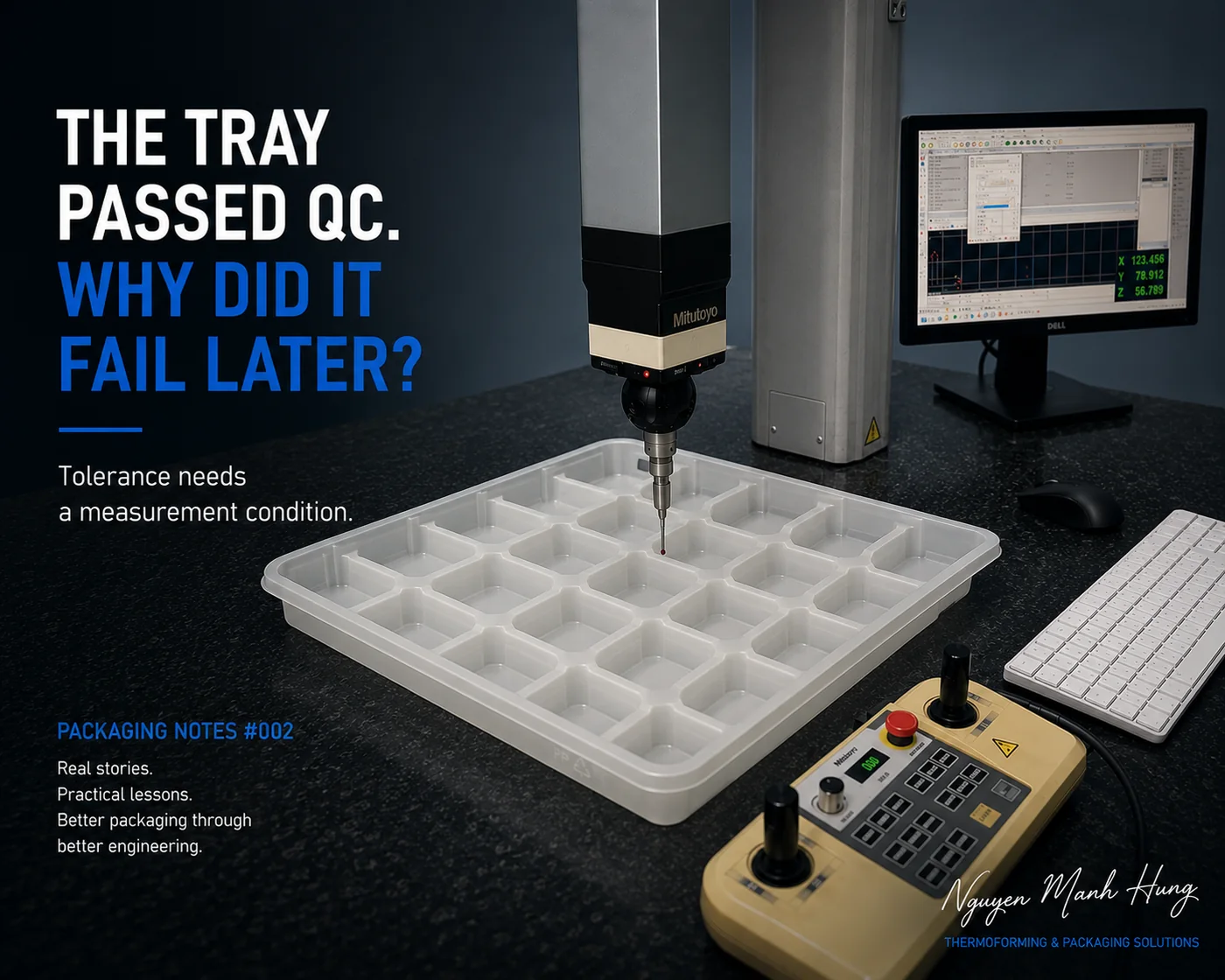
Both measurements were correct. Thermoformed plastic keeps moving after demould — PP and HDPE can keep crystallising, and shrinking, for 24 to 48 hours after forming, depending on grade, cooling and geometry. Just 0.2% of late shrinkage on a 300 mm tray is 0.6 mm, which consumes a full ±0.5 mm tolerance. The fix costs nothing: write the measurement condition onto the drawing — "Dimensional inspection: 48 h after forming, at 23 ± 2 °C."
The engineering problem
The thermoformed PP tray passed final inspection on Friday. On Monday, the customer’s incoming QC measured the same tray — out of tolerance.
Claim email, photos, a polite request for 8D. Supplier records: pass. Customer records: fail. Soon both sides are questioning each other’s calipers.
Nobody made a mistake. Both measurements were correct — they just measured two different trays that happened to be the same tray.
Why it happens
Thermoformed plastic keeps moving after demould. Post-forming shrinkage is real, and it is material-dependent.
PP and HDPE keep crystallising — and shrinking — for 24 to 48 hours after forming, depending on grade, cooling and geometry. HIPS and APET usually settle faster.
Key variables
| Question | What the numbers say |
|---|---|
| Can a little shrinkage really kill a tolerance? | 0.2% of late shrinkage on a 300 mm tray is 0.6 mm — a full ±0.5 mm tolerance, gone |
| How long does PP or HDPE keep moving? | 24–48 hours after forming, depending on grade, cooling and geometry |
| Is every material this risky? | Not equally. HIPS and APET usually settle faster, typically 0.2–0.7% total |
| Why didn’t the TDS warn us? | Of 17 supplier TDS in our own library, exactly one publishes a shrinkage value |
The material decides how dangerous Friday-to-Monday is.
Test conditions
A tolerance without a measurement condition is only half a spec. The condition that removes the ambiguity is a single line:
Dimensional inspection: 48 h after forming, at 23 ± 2 °C.
What engineers should check
- Whether the drawing states when after forming the dimension is measured, and at what temperature
- Whether the material chosen is one that settles quickly, or one that keeps moving for two days
- Whether the supplier’s TDS publishes a shrinkage value at all
What buyers should ask their supplier
- What is the post-forming shrinkage of this specific grade, and over what period?
- At what point after forming was the inspection report measured?
- Can incoming inspection and outgoing inspection use the same stated condition?
Engineering note
The fix costs nothing. It is one line on the tray drawing, agreed before tooling. Half a spec is where supplier–customer disputes are born.
Good packaging should be practical, not just presentable.
Related Engineering Notes
Related KONIX solution
Related industry
Have a similar packaging problem?
Upload your drawing, specification or current packaging and let our engineering team review it.