
Holding the Product Is Only Step One — What a Tray Design Review Should Actually Check
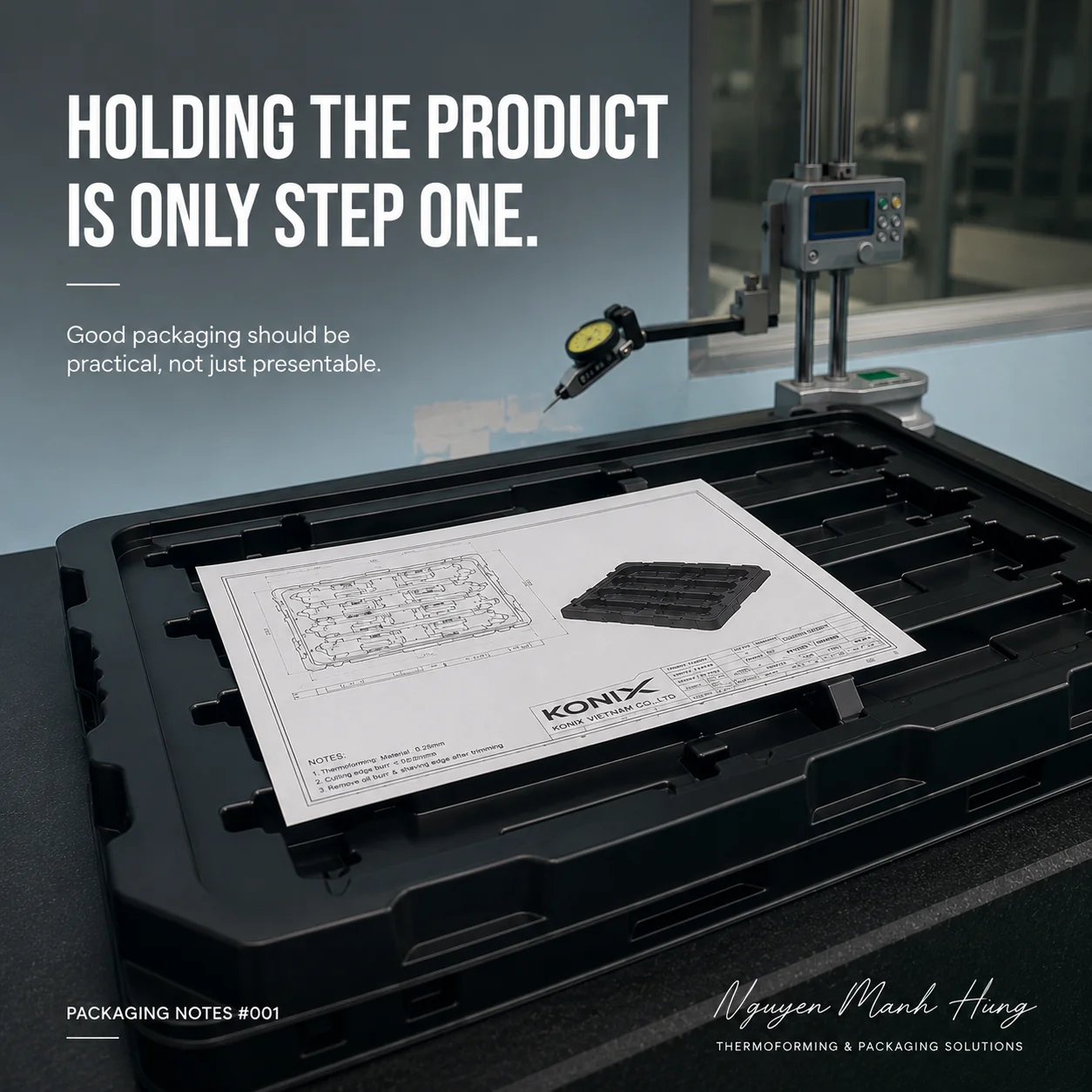
For many people a thermoformed tray has one job — hold the product. Fitting the product is only step one. A tray can fit perfectly, pass the approval meeting, and still fail three months later: it deforms in the customer's warehouse, the stack collapses in transport, or an automated pick-and-place line starts missing parts because the pocket tolerance drifted after forming. A design review should therefore ask about shrinkage, stacking, handling and automation stability — not only about fit.
The engineering problem
A tray that fits the product is not the same thing as a tray that works. Three failure modes show up months after the approval meeting, when the drawing is long closed:
- trays deform in the customer’s warehouse
- stacking collapses during transport
- an automated pick-and-place line keeps missing parts because the pocket tolerance drifted after forming
None of these are visible at the sample stage. All three are decided at the drawing stage.
What engineers should check
When reviewing a tray design, fit is not the question. The real questions are:
- How does the material shrink after forming — and does the tolerance still hold? Post-forming movement is the reason a pocket that measured correctly at the factory can be out of position weeks later. This is covered in detail in Packaging Notes #002.
- Can it stack safely at real warehouse humidity and temperature? Not laboratory conditions — the conditions the stack will actually sit in.
- Does it survive real handling, not just the drop test?
- Is it stable enough for automation, batch after batch? Consistency between batches matters more to an automated line than the accuracy of any single batch.
Engineering note
Sometimes the difference is just a few millimetres — a deeper stacking shoulder, a slightly larger draft angle — decided at the drawing stage, long before mass production.
Good packaging development connects the drawing, the material, the production process, QA control, warehouse handling, and actual customer usage. When those six are reviewed together, most of the failures above never reach the customer.
Good packaging should be practical, not just presentable.
Related Engineering Notes
Related KONIX solution
Related industry
Have a similar packaging problem?
Upload your drawing, specification or current packaging and let our engineering team review it.